Cloud Phone Development Trends
Cloud-based virtual native Android/iOS systems simulate physical phones, enabling service-oriented mobile tool attributes
Cloud Phone Evolution Timeline
Enlightenment
(2011-2014)
Cloud Sync
(Collaborative Phone)
Representative products: Huawei Cloud Vision, Ali Tianyu, Baidu, Lenovo, etc.
Exploration
(2014-2018)
Cloud Hosting
(Cloud Phone 1.0)
Representative products: Red Finger, Nextbit Robin, AiYunTu, NoxPlayer Cloud
Development
(2018-Present)
Cloud Terminal
(Cloud Phone 2.0)
Representative products: Baidu Cloud Phone, Kunpeng Cloud Phone, Tianyi Cloud Phone, Mobile Cloud Phone, Octopus Cloud Phone
Cloud Phone Evolution Direction
Cloud Phone 1.0: Hosted Cloud Phone
- • Single application, low-frequency interaction
- • Mainly for game idle scenarios
Cloud Phone 2.0: Personal Cloud Phone
- • Ecosystem-based, scenario-based, intelligent applications
- • High-frequency interaction
Cloud Phone Core Advantages
Six core advantages leading cloud phone technology development
Mature Products & Solutions
- Comprehensive IaaS, PaaS, SaaS products and solutions for cloud phone scenarios
- Supporting ecosystem products and solutions around cloud phone applications
- Years of accumulated cloud phone application cases and experience
Customized Cloud Phone OS
- Host kernel-based streaming solution, both secure and efficient
- Flexible, stable simulation technology with higher compatibility and better experience
- Scenario-based cloud phone OS customization to maximize different business needs
Grasping Cloud Phone Essence
- Industry-leading performance in latency, quality, and stability metrics
- AI and RPA integration for intelligent cloud phone application scenarios
- Maximize hands-free experience for healthy mobile app usage
Autonomous Technology Ecosystem
- Full-stack hardware and software R&D capabilities providing solid cloud infrastructure
- Rapid, flexible response to diverse R&D and business requirements
- Always at the forefront of cloud phone technology
Cost-Effective SoC ARM Array Servers
- High-density, high-performance SoC ARM array servers with costs half of traditional X86 or large ARM servers
- Virtualization container technology for system-level multi-instance, minimizing single cloud phone costs
Continuous R&D Investment & Tech Exploration
- Adhere to "commercialize one generation, develop one generation, research one generation" strategy
- Continuous ARM server iterative development
- Ongoing research in video perception encoding, super-resolution, streaming optimization, simulation, and AI applications
Access Features
Support Multi-Platform Access (Android, iOS, PC)
Support Batch Control and Synchronous Operations
Support Grouping, Authorization, Sharing, and Transfer Management
Support One-Click New Device Setup
Support Local Input Methods
Support Camera, Microphone and Other Peripheral Access
Technical Architecture
Three-tier cloud-native architecture technology system
IaaS Layer
Provides computing, storage, network and other basic resources
PaaS Layer
Provides cloud phone runtime environment and development platform
SaaS Layer
Provides cloud phone applications and solutions
Cloud Phone Application Scenarios
Comprehensive coverage across life, work, study, social, and entertainment dimensions
Daily Life Application Scenarios
Application Manager
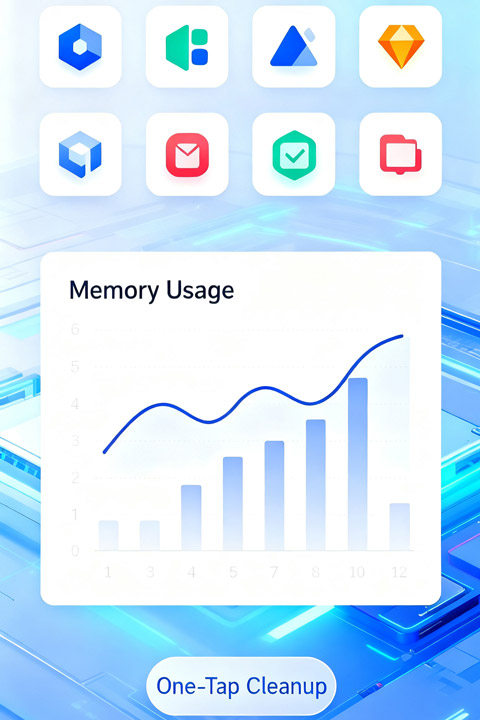
Pain Point Analysis:
- Mobile application fragmentation is becoming increasingly serious
- Phone load is becoming increasingly heavy
- Mobile application usage time is becoming increasingly fragmented
- People are becoming increasingly dependent on phones
Solution Highlights:
- Cloud hosting of zombie applications on mobile terminals to reduce phone burden
- Intelligent operation of cloud applications through RPA+AI to help users "free their hands"
- No terminal restrictions, access anytime and anywhere, reducing user dependence on phones
- Enable automated information flow across applications and devices
Work Application Scenarios
Mobile Cloud Office
Pain Points:
- Fragmented data assets with serious asset loss
- Apps need cross-OS support with high adaptation costs
- Mixed personal and work phones, difficult to manage uniformly
Solution Highlights:
- Unified collection and centralized management of fragmented data assets
- Data doesn't land on work terminals, all centrally stored in the cloud
- Centralized app management, one-click distribution, unified upgrades
APP Cloud Testing
Pain Points:
- Real device testing requires large upfront investment with high maintenance costs
- Simulator compatibility and stability issues affect testing effectiveness
Solution Highlights:
- High-fidelity testing environment based on native APP runtime environment
- Elastic scheduling of testing resources based on testing requirements
- Automatic test operation execution through AI+RPA technology
Learning Application Scenarios
Student Customized Phone
Pain Points:
- Phone's learning tool attributes are inseparable from life tool and entertainment tool attributes
- Students are addicted to phones but cannot break free from phone dependency
Solution Highlights:
- Student phone OS system starts and runs in the cloud, avoiding firmware hacking
- Convenient for parents and schools to monitor and manage student phone usage in real-time
Smart Classroom Empowerment
Pain Points:
- Smart classrooms require open network environments, posing challenges to school network security management
- Students use school networks for activities unrelated to learning
Solution Highlights:
- Achieve complete physical isolation between classroom internal and external networks
- Centralized app management, one-click distribution, unified upgrades
Social Application Scenarios
Super Social Space
Entertainment Application Scenarios
Mobile Game Cloud Hosting
Pain Points:
- Unstable mobile network connections may cause game disconnections
- Frequent switching between games and other apps causes distraction
Solution Highlights:
- Games hosted in cloud, running 24/7 without interruption
- No terminal storage consumption, no local traffic or battery usage
Game Trial Advertising
Pain Points:
- Traditional game ads are disconnected from game content
- Some game ads lack creativity and novelty
Solution Highlights:
- Users can try games online through trial portal without download/installation
- Provides low-latency, high-definition gaming experience
Cloud Gaming
Pain Points:
- Game installation packages are increasingly large, requiring significant storage and traffic
- Increasingly high terminal phone configuration requirements, high upgrade costs
Solution Highlights:
- Games run online through local terminal portal without download/installation
- Provides low-latency, high-definition gaming experience